Differentiation
Three Departures from Conventional VHP
Conventional VHP is a surface-contact sterilant operating inside a narrow physical envelope. PuroGen's platform departs from that envelope on three axes — each a direct consequence of invention, not adaptation.
01
What Conventional VHP Can and Cannot Do
VHP as a category is a gas-phase oxidant. It achieves terminal sterilization (SAL 10⁻⁶) at low temperature. These properties are shared by all VHP platforms. The regulatory framework — ISO 22441, FDA Category A — applies equally to all. These are category properties.
The constraints are also category-level but rarely stated publicly. Conventional VHP is fundamentally a surface-contact process — the vapor contacts exposed surfaces, oxidizes microbial membranes, then decomposes. In standard operating configurations, the vapor does not drive deeply into porous or dense substrates. The moisture envelope is narrow: above approximately 4% RH, hydrogen peroxide condenses, disrupting cycle kinetics and invalidating the process. And cycle parameters are typically fixed around equipment defaults, not engineered for the specific product being sterilized.
These are not failures of the category. They are the operating assumptions of conventional VHP — and they define the boundary of what can be sterilized. PuroGen's inventions work at that boundary. Three departures, developed from first principles over three decades, expand what is addressable.
Surface Contact
Conventional VHP's primary mechanism — vapor contacts exposed surfaces
≤ 4% RH
Industry-typical moisture ceiling — above this, condensation disrupts the sterilization cycle
Fixed Cycles
Conventional cycle architecture — parameters designed around equipment defaults, not the product
02 — Departure One
Penetration into Porous and Dense Substrates
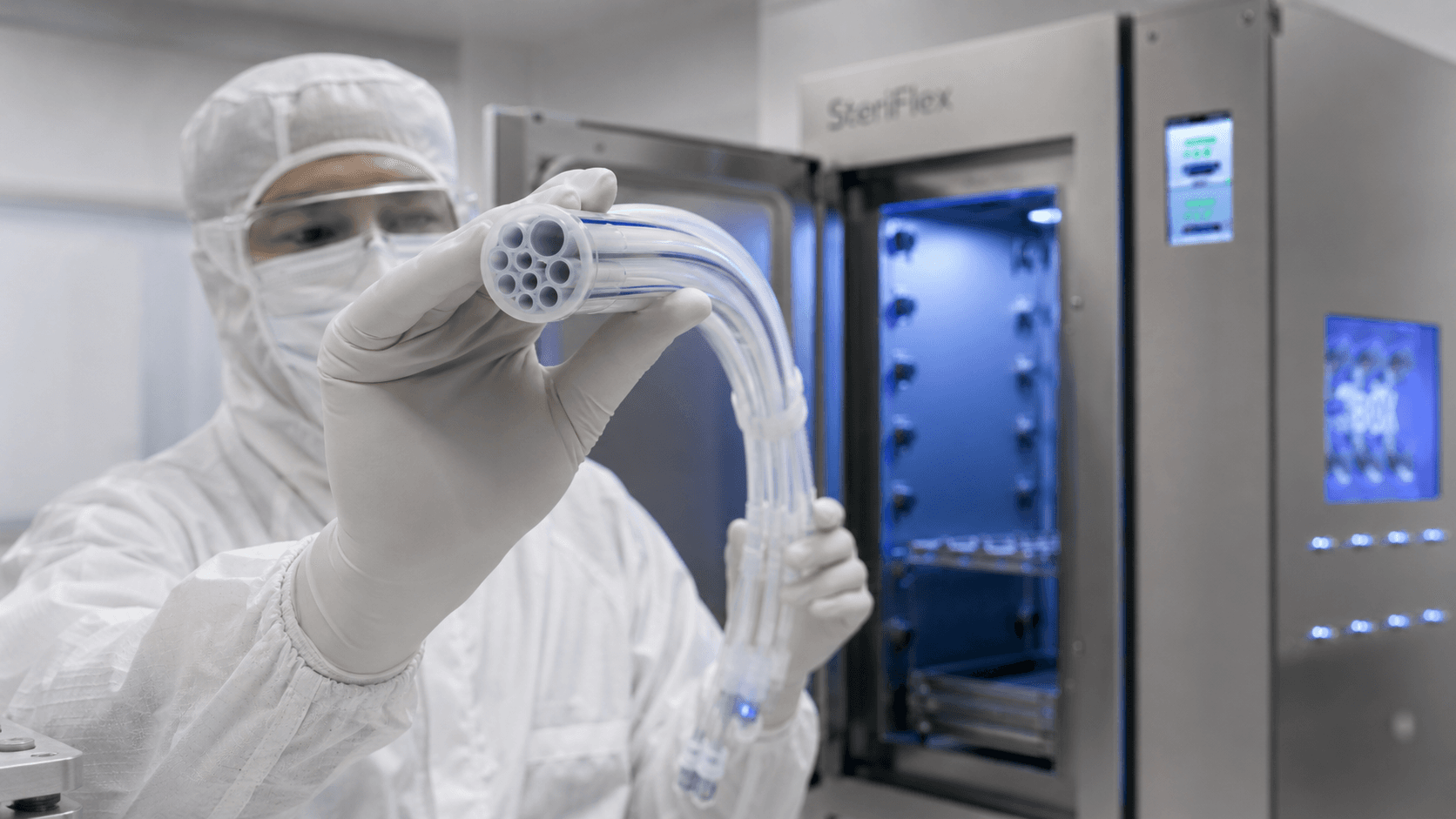
Conventional VHP works on what vapor can reach without resistance — exposed surfaces, open lumens, simple geometries. The vapor phase is an advantage over liquid sterilants, but the advantage is not unlimited. Dense polymer matrices, multilayer packaging assemblies, multi-lumen catheters, and biologic carriers with internal porosity present physical barriers that standard VHP does not reliably penetrate to the depths that sterilization validation requires.
PuroGen's platform drives penetration into these structures. The mechanism is a function of vapor pressure management, cycle phase sequencing, and parametric control over the diffusion gradient across the sterilization cycle — not simply increasing concentration. The result is validated sterilization in geometries and substrates that remain outside the reliable operating range of conventional VHP.
This is the physical basis for PuroGen's extension into agricultural substrates, dense tissue matrices, and complex device geometries. It is not a new application of standard VHP. It is a different operating characteristic.
The question is not whether vapor can reach a surface. It is whether vapor can be driven into a substrate.
03 — Departure Two
A Wider Moisture Operating Range
The moisture constraint in conventional VHP is a physical reality, not a regulatory choice. Hydrogen peroxide vapor condenses into liquid above a threshold relative humidity. When condensation occurs, the gas-phase kinetics that produce validated sterilization are disrupted. Standard VHP systems require residual moisture at or below approximately 4% RH before and during the sterilization cycle. That drying step is not trivial — it is time-consuming, and for some materials, it is damaging.
PuroGen's platform operates at residual moisture levels up to approximately 20% RH. The mechanism involves proprietary cycle phase management that maintains vapor-phase chemistry within the sterilization chamber at moisture levels that would produce condensation — and validation failure — in a conventional system.
What this enables: materials that cannot be dried to bone-dry without loss of structural integrity, bioabsorbable polymers sensitive to aggressive dehydration, hydrogel-based devices, and substrates where the moisture content is part of the product specification.
≤ 4% RH
Industry-typical residual moisture ceiling — drying to this level required before and during conventional VHP cycles
~20% RH
PuroGen operating range — up to approximately 20% residual moisture, maintained in vapor phase through proprietary cycle management
Drying a material to bone-dry before sterilization is not always acceptable. The moisture envelope is not a process detail — it determines what can be sterilized.
04 — Departure Three
Product-Specific Cycles Authored by PuroGen, Validated by the Customer
Conventional VHP cycle parameters are typically designed around equipment defaults — validated for general-purpose use, adjusted within narrow limits for specific loads. The validation is conducted by the equipment vendor or a contract sterilization facility. The customer operates within that validated envelope. Process knowledge stays with the vendor.
PuroGen's engagement model inverts this. For each product or device portfolio, PuroGen's process engineers author a cycle specific to that substrate — dwell times, reagent dosing, vacuum profiles, humidity parameters, and phase sequencing designed around the material, the geometry, and the bioburden profile. The cycle is then installed on PuroGen-manufactured equipment delivered to the customer's facility.
The customer runs the validation. Under PuroGen's authored protocol and the ISO 22441 / FDA Category A framework, the customer's quality management system conducts IQ/OQ/PQ and owns the audit trail. The customer is not dependent on PuroGen to operate or maintain the validated process — they hold it. PuroGen's role is process authorship and platform supply. The customer's role is validation ownership and operational control.
PuroGen Authors
Dwell times, reagent dosing, vacuum profiles, and humidity parameters engineered for the customer's specific product and material profile.
Customer Validates
IQ/OQ/PQ conducted by the customer under PuroGen-authored protocol. ISO 22441-aligned documentation from day one.
Customer Owns the Audit Trail
The validated process is the customer's internal asset. No ongoing vendor dependency for regulatory operation.
05
Conventional VHP vs. PuroGen VHP
Five criteria. Same category — different operating characteristics.
| Conventional VHP | PuroGen VHP | |
|---|---|---|
| Penetration Depth | Surface contact and near-surface diffusion into simple geometries | Driven penetration into porous substrates, multi-lumen geometries, and dense material matrices |
| Moisture Operating Range | ≤ 4% RH — condensation above this threshold disrupts cycle kinetics and invalidates the process | Up to ~20% RH — wider moisture envelope enables materials that cannot be processed in a bone-dry environment |
| Cycle Architecture | Fixed or semi-adjustable cycles, typically designed around equipment defaults | Product-specific cycles authored by PuroGen's process engineers for the customer's specific substrate and load |
| Validation Ownership | Validation conducted by equipment vendor or contract sterilization facility; customer dependency | PuroGen authors the protocol; customer runs validation on PuroGen equipment; customer's QMS owns the audit trail |
| Regulatory Framework | Category A (established method) — same ISO 22441 / FDA pathway | Category A + product-specific cycle documentation structured for ISO 22441 / FDA Category A submission from the outset |
Penetration Depth
Moisture Operating Range
Cycle Architecture
Validation Ownership
Regulatory Framework
06
What Becomes Addressable
Each departure expands the boundary of what can be validated, processed, and delivered to a regulated market.
Medical Devices
Multi-lumen catheters, complex device assemblies, packaging configurations that concentrate moisture — products that exceed the reliable sterilization envelope of conventional VHP. Penetration depth and moisture tolerance are not academic distinctions here. They determine whether a device can receive a validated SAL 10⁻⁶ label.
Medical device sterilizationAllograft Tissue & Biologics
Dense tissue matrices, biologic carriers with internal porosity, materials where aggressive drying compromises osteoinductivity or growth factor activity. T10⁶® exists because conventional VHP cannot reliably penetrate allograft bone while preserving biological integrity. Both departures — penetration and moisture range — are active in this application.
Allograft tissue processingPharmaceutical & Regulated Manufacturing
Hydrogel-based products, bioabsorbable polymers, devices with moisture-sensitive coatings, isolator and cleanroom decontamination where residual surface moisture is unavoidable. The programmable cycle model supports in-house sterilization with full regulatory documentation — without dependency on contract sterilization capacity.
Pharmaceutical applicationsBring Your Product. We'll Author the Cycle.
PuroGen's process engineers work from your specific substrate, geometry, and bioburden profile — not from equipment defaults. The result is a cycle built for your product, documented for your regulatory submission, and validated by your quality management system.