Technology
The Science of Pure®
An integrated innovation ecosystem — invented from first principles, validated through decades of regulated application, and aligned with the trajectory of global sterilization standards.
Mechanism of Action
Vaporized Hydrogen Peroxide (VH₂O₂)
VHP sterilization operates through gas-phase oxidation — a fundamentally different mechanism from irradiation, chemical alkylation, or thermal denaturation. The vapor phase delivers sterilant to surfaces that liquid and plasma methods cannot reach, then decomposes cleanly to water and oxygen.
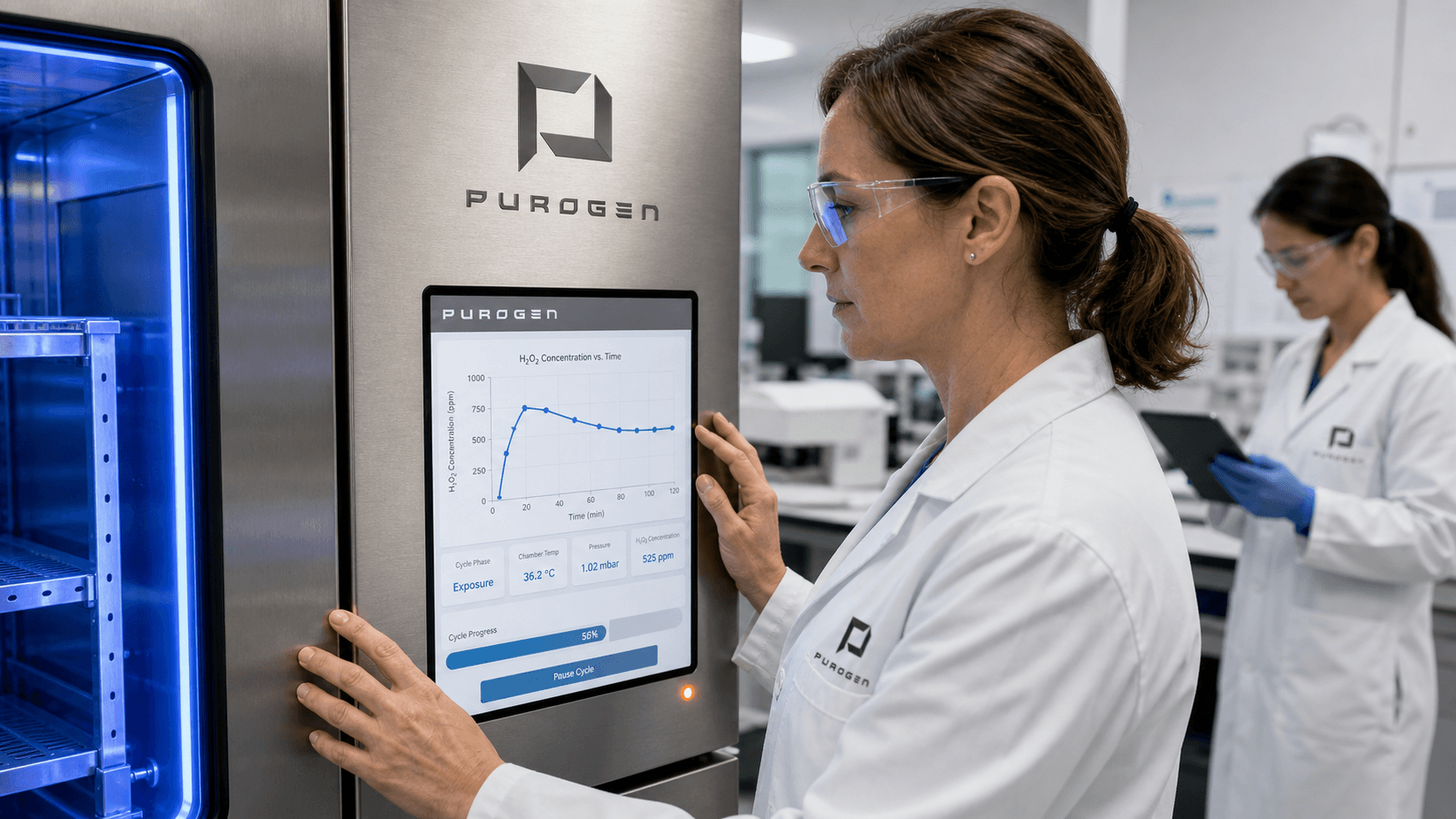
Generation
Liquid hydrogen peroxide is flash-vaporized into a gas-phase sterilant. Precise concentration control ensures reproducible dosing across every cycle.
Distribution
Vaporized H₂O₂ penetrates complex geometries and porous materials. The vapor phase reaches surfaces that liquid and plasma methods cannot access.
Sterilization
Reactive oxygen species oxidize microbial cell membranes, DNA, and essential enzymes. Achieves SAL 10⁻⁶ — the gold standard for sterility assurance.
Decomposition
H₂O₂ catalytically decomposes to water vapor and oxygen. Zero toxic residue. No aeration required. No environmental burden.
Liquid Phase
Surface contact only. Limited penetration into lumens and porous structures. Potential material incompatibility.
Vapor Phase
Gas-phase penetration of complex geometries. No condensation damage. Complete surface coverage.
Plasma Phase
Ionized gas with limited penetration depth. Restricted to surface sterilization. Not suitable for lumens.
Within Vapor Phase
Not all vapor-phase VHP platforms perform equally.
Vapor phase penetration is a category advantage over liquid and plasma sterilants. But within vapor-phase VHP, penetration depth, moisture operating range, and cycle programmability vary significantly between conventional systems and PuroGen's platform. These are the axes on which PuroGen was invented to depart from industry norms.
Three departures from conventional VHPComparative Analysis
Sterilization Methods Compared
Five established sterilization modalities evaluated across the criteria that matter most to regulated manufacturers — material preservation, safety profile, and regulatory trajectory.
| VHP | EtO | Gamma | Steam | E-beam | |
|---|---|---|---|---|---|
| Operating Temperature | Room temperature (25–50°C) | 37–63°C | Ambient | 121–134°C | Ambient |
| Toxic Residue | None — decomposes to H₂O + O₂ | Carcinogenic residues require aeration | None | None | None |
| Material Compatibility | Excellent — polymers, metals, electronics | Good for most materials | Degrades polymers and biologics | Limited — heat-sensitive materials excluded | Degrades some polymers |
| Biological Integrity | Preserved — osteoinductivity, growth factors intact | Generally preserved | Damaged — reduced mechanical properties | Damaged — protein denaturation | Partially damaged |
| Radiation Source | Not required | Not required | Cobalt-60 source required | Not required | Electron accelerator required |
| Aeration Time | None | 12–72 hours required | None | Drying cycle required | None |
| Regulatory Status | FDA Category A (Jan 2024), ISO 22441, EU MDR harmonized | Established — under EPA restriction | Established | Established | Established |
| Environmental Impact | Minimal — water and oxygen byproducts | Significant — EPA mandating 90% emission cuts | Radioactive source disposal | High energy consumption | Moderate energy consumption |
Operating Temperature
Toxic Residue
Material Compatibility
Biological Integrity
Radiation Source
Aeration Time
Regulatory Status
Environmental Impact
Heritage
Invented, Not Adapted
STERIS ($24B) and Ecolab/Bioquell ($48B) acquired their VHP capabilities through M&A. PuroGen invented from first principles — three decades of primary research, validation, and refinement.
The distinction matters. When a conglomerate acquires VHP technology, it inherits a product line. When an inventor develops VHP technology, it builds understanding — the kind of deep expertise that resolves complex sterilization challenges where standard protocols fail.
PuroGen's patent portfolio reflects sustained original work in vapor-phase chemistry, supercritical fluid processing, and parametric sterilization control. This is not technology purchased at market — it is technology created at the bench.
Platform Architecture
An Integrated Technology Ecosystem
Four interconnected systems — each addressing a distinct sterilization challenge, all sharing a common foundation in oxidative chemistry and parametric process control.
SteriFlex™
Patented VHP Sterilization
Complete parametric customization — dwell times, reagent dosing, vacuum settings, and up to ~20% RH humidity capability. Cycle parameters authored by PuroGen for your specific product and substrate. SAL 10⁻⁶ validated.
Learn moreT10⁶®
Two-Stage Tissue Sterilization
Two-stage non-irradiated terminal sterilization for allograft tissue — cold sterilization stage followed by SteriFlex™ VHP. Pioneered in 2006, nearly two decades before industry adoption of non-irradiated methods.
Learn moreTheBOX®
Enclosed VHP Chamber
Patented enclosed sterilization chamber designed for integration into cleanroom, laboratory, and manufacturing environments.
Details forthcomingReactive Oxygen™
Advanced Oxidation Chemistry
Proprietary reactive oxygen species formulation for surface decontamination and environmental bioburden reduction.
Details forthcomingRegulatory Landscape
Aligned with the Regulatory Trajectory
The global regulatory framework is converging on VHP as a primary sterilization modality. PuroGen's technology portfolio was built for this moment.
Category A
FDA reclassified VHP from novel (Category B) to established (Category A) — January 8, 2024
ISO 22441
International standard governing VHP sterilization of healthcare products
90%
EPA-mandated reduction in ethylene oxide emissions — driving industry transition
What This Means
VHP is no longer an emerging alternative. It is a recognized, standards-backed sterilization modality with dedicated ISO guidance and FDA classification. The regulatory trajectory favors organizations with established VHP expertise.
PuroGen's Position
VHP development predating regulatory recognition by nearly two decades. Validated platforms already achieving the sterility assurance levels that new standards require. The science was ready before the standards caught up.
Adoption
The Convergence That Makes Adoption Practical
Three independent regulatory actions have converged to create a defined pathway for VHP adoption: the FDA's Category A reclassification establishes VHP as a peer to steam and EtO; ISO 22441 provides the international consensus standard for validation — referenced by the FDA, EU Notified Bodies, and regulatory authorities globally; and EPA ethylene oxide restrictions create urgency for device manufacturers to transition.
For manufacturers selling into both the U.S. and European markets, the convergence is particularly significant. ISO 22441 gives VHP the same standards-based pathway that EtO manufacturers use through ISO 11135 — enabling CE marking under EU MDR 2017/745 and FDA clearance from a single validation framework.
This is not a speculative window. These are documented regulatory actions with compliance timelines across multiple jurisdictions. The question for device manufacturers is no longer whether VHP is viable — it is how quickly they can validate a system for their specific device portfolio.
PuroGen has been operating VHP sterilization under FDA regulation since 2003 — over two decades before the standard caught up. Custom chambers. Validated parameters. Audit-ready documentation.
Explore the Platform
From molecular mechanism to validated system — see how PuroGen's technology translates to your sterilization requirements.