Medical Devices
The Runway to In-House Sterilization Just Shortened
FDA Category A recognition. ISO 22441 published. EPA restricting ethylene oxide. For medical device companies evaluating in-house VHP sterilization, the regulatory pathway is now defined — and PuroGen has been operating it for over two decades.
Industry Transition
The Ethylene Oxide Crisis
Approximately 50% of all medical devices requiring sterilization use ethylene oxide. That dependency is becoming untenable.
90%
EPA-mandated reduction in EtO emissions from sterilization facilities
50%
Share of sterile medical devices currently processed with ethylene oxide
$5B+
Estimated annual market for medical device sterilization services
Regulatory Pressure
The EPA has finalized rules requiring 90% reduction in ethylene oxide emissions from commercial sterilization facilities. Compliance timelines are accelerating, and facility expansions using EtO face growing regulatory barriers.
Community Opposition
Communities near EtO sterilization facilities have organized against continued operations. Cancer risk data and air quality monitoring have intensified public pressure, leading to facility closures and operational restrictions.
Safety Concerns
EtO is classified as a known human carcinogen. Worker exposure limits are tightening, and the 12–72 hour aeration period required to remove toxic residues from sterilized devices adds cost, complexity, and risk to every cycle.
FDA Acknowledgment
The FDA has publicly acknowledged the need for viable EtO alternatives and has taken concrete steps — including reclassifying VHP to Category A — to facilitate industry transition to non-toxic sterilization methods.
Established Alternative
VHP Is Not Experimental — It Is Recognized
On January 8, 2024, the FDA reclassified vaporized hydrogen peroxide (VH₂O₂) from Category B (novel) to Category A (established) — placing VHP alongside steam and EtO as a recognized sterilization modality.
FDA reclassifies VHP to Category A
VHP moves from novel (Category B) to established sterilization method — recognized alongside steam and EtO
ISO 22441 published
International standard for sterilization of health care products using vaporized hydrogen peroxide (VH₂O₂)
EPA EtO emission mandates
90% reduction in ethylene oxide emissions required — driving industry-wide search for alternatives
EU MDR alignment via ISO 22441
ISO 22441 provides Notified Bodies with a harmonized standard for assessing VHP sterilization — enabling CE marking for VHP-sterilized devices under MDR 2017/745 without novel justification
What Changed
What Category A and ISO 22441 Mean for Device Manufacturers
The January 2024 reclassification and the simultaneous publication of ISO 22441 are not independent events. Together, they establish a unified regulatory and standards framework for VHP sterilization — with direct consequences for manufacturers in the United States, the European Union, and every market that references ISO standards.
FDA: Reduced Regulatory Burden
Category A means the FDA no longer considers VHP an emerging technology requiring novel justification. The burden of demonstrating method suitability is reduced — though process-specific validation remains required.
ISO 22441: Defined Validation Pathway
ISO 22441:2022 provides the international consensus standard for VHP sterilization validation — IQ/OQ/PQ requirements, process development protocols, and quality management frameworks. This is the standard referenced by both the FDA and EU Notified Bodies.
EU MDR: Standards-Based CE Marking
Under the EU Medical Device Regulation (MDR 2017/745), Notified Bodies assess sterilization processes against harmonized standards. ISO 22441 gives VHP the same standards-based pathway that EtO manufacturers use through ISO 11135 — enabling CE marking for VHP-sterilized devices without novel justification.
Parity in Regulatory Submissions
VHP now occupies the same regulatory standing as steam, dry heat, EtO, and irradiation in FDA 510(k)/PMA submissions and EU technical documentation. Manufacturers can reference an established evidence base rather than building the case from scratch — in any major regulatory market.
In-House Feasibility
The combination of Category A clarity, ISO 22441 validation frameworks, and PuroGen's custom system capability means bringing VHP sterilization in-house is no longer a multi-year regulatory experiment. It is a defined engineering project — with a single validation standard recognized globally.
Global Market Access
Manufacturers validating against ISO 22441 produce documentation recognized by the FDA, EU Notified Bodies, Health Canada, TGA (Australia), and regulatory authorities across Asia-Pacific. One validation standard. Multiple market clearances.
For medical device companies that cannot use irradiation — due to material sensitivity, device electronics, or patient safety concerns — VHP is the only established alternative with a standards-based validation pathway recognized by the FDA, EU Notified Bodies, and international regulatory authorities.
The PuroGen Approach
Not One-Size-Fits-All
Medical device sterilization is not a generic problem. Every device portfolio presents unique material constraints, geometric challenges, and regulatory requirements. A sterilization transition demands a platform that can be validated for your specific needs — not a fixed-cycle system that forces design compromises.
SteriFlex™ provides complete parametric customization — adjustable dwell times, reagent dosing control, flexible vacuum settings, and a moisture operating range up to ~20% RH versus industry-typical ≤ 4% RH, enabling materials that cannot be dried to bone-dry without integrity loss. The sterilization process is engineered around your device, not the other way around.
And you're not working with a distributor or a product-line manager. You're working with the team that invented the technology — deep VHP expertise applied directly to your sterilization challenge.
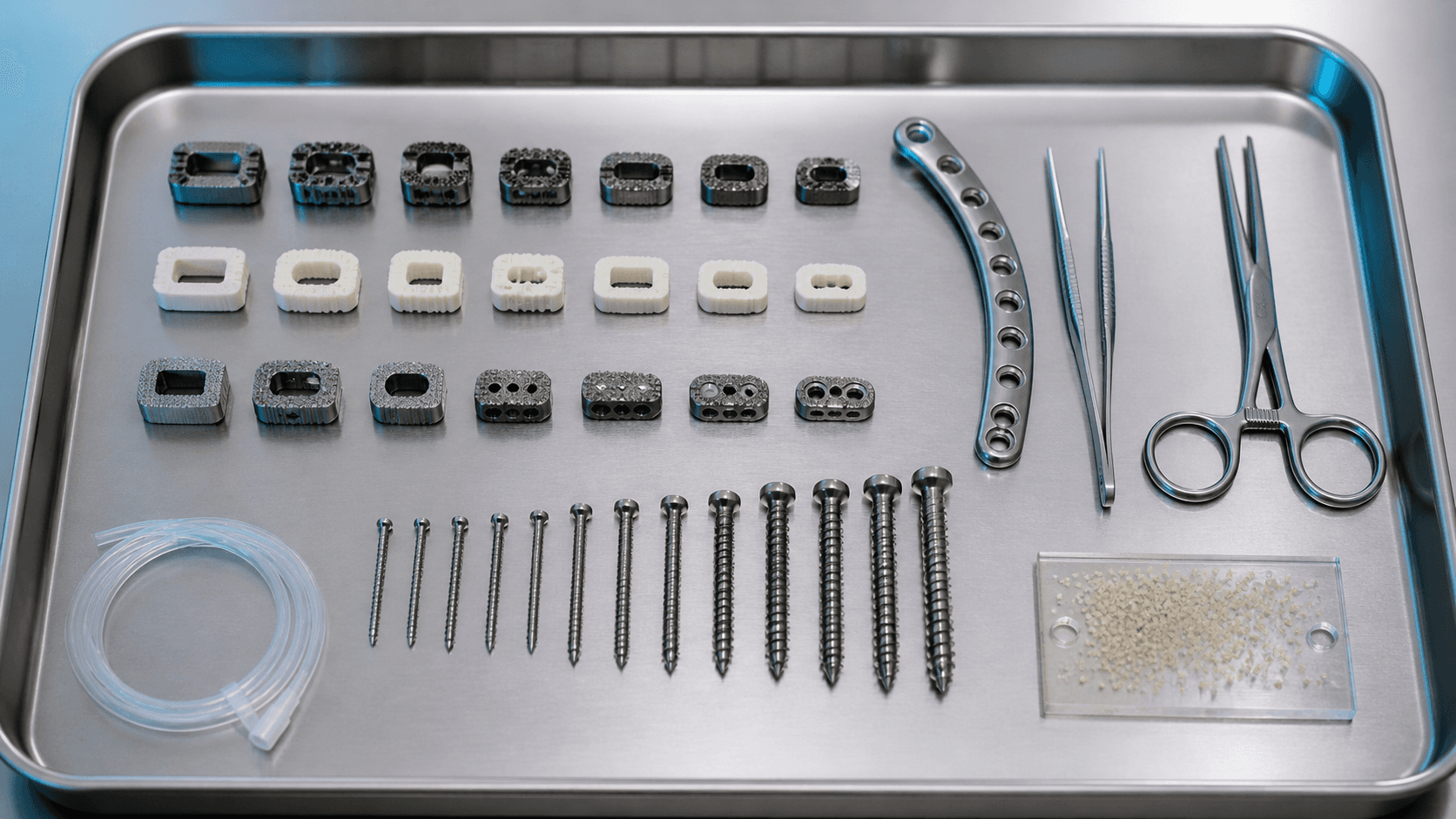
Material Compatibility
Broad Compatibility, Zero Residue
VHP sterilization operates at room temperature and decomposes to water and oxygen. No heat damage. No toxic residue. No aeration time.
Polymers
PEEK, PTFE, polyethylene, polypropylene, silicone, PVC
Metals
Stainless steel, titanium, cobalt-chrome, aluminum alloys
Electronics
Sensors, circuit boards, battery-powered devices
HEPA Filters
Filter media integrity preserved through low-temperature processing
Optics
Lenses, fiber optics, camera systems for endoscopic devices
Composites
Multi-material assemblies, coated surfaces, adhesive bonds
25–50°C
Operating temperature — no thermal damage to heat-sensitive components
H₂O + O₂
Decomposition products — zero toxic residue on sterilized devices
0 hrs
Aeration time required — immediate post-cycle availability
Clarification
What VHP Sterilization Is — and What It Is Not
VHP Sterilization IS
Controlled vacuum sterilization with validated parameters
Driven substrate penetration into multi-lumen geometries, porous polymer matrices, and complex device assemblies — beyond the reliable range of conventional VHP
Low-temperature compatible — safe for polymers, electronics, batteries
Residual-free — decomposes to water and oxygen
ISO 22441:2022 validated, FDA Established Category A
Suitable for in-house deployment with custom system engineering
VHP Sterilization IS NOT
Ionizing radiation (gamma, e-beam, X-ray)
Ethylene oxide with residual toxicity concerns
Ozone-based processing (Category B — no recognized standard)
Surface-only decontamination
A one-size-fits-all contract sterilization model
An experimental or novel methodology requiring special justification
Partnership
VHP Expertise from the Inventor, Applied to Your Challenge
Category A recognition defines the regulatory pathway. ISO 22441 defines the validation standard. What remains is the engineering — building a system configured for your specific device portfolio, validated against your specific regulatory requirements, and installed in your facility. That is what PuroGen does.
We work with device manufacturers and contract sterilization organizations to design, build, validate, and commission custom VHP systems. The engagement model is flexible: license the SteriFlex platform for in-house sterilization, partner on a private-label basis, or explore a deeper strategic collaboration that leverages PuroGen's complete technology portfolio.
Outsourced sterilization is a dependency. In-house sterilization is a capability.
Device Manufacturers
Validate VHP for your specific device portfolio with PuroGen's engineering support and regulatory expertise.
Contract Sterilizers
Add VHP capability to your service offering with a proven, customizable platform — expand your portfolio beyond EtO.
Strategic Partners
Co-develop VHP solutions for emerging device categories or explore licensing arrangements for your market.
Within VHP
Why PuroGen VHP performs where conventional VHP does not.
For medical devices with multi-lumen geometries, moisture-sensitive materials, or packaging configurations that challenge standard processing — the distinction between conventional VHP and PuroGen's platform is not marginal. Penetration into dense substrates, a moisture operating range up to ~20% RH, and product-specific cycles authored for your device are the axes on which PuroGen was invented.
Three departures from conventional VHPBegin the Transition
The regulatory trajectory is clear. The technology is validated. The question is not whether the industry transitions away from EtO — but how your organization gets there.