Capabilities
Prove the Process. Then Build the System.
PuroGen validates process feasibility on its own platform before a custom system is engineered. R&D subcontract manufacturing gives you real validation data — and the confidence to commit capital.
Engagement Model
Two Phases. One Continuous Pathway.
Most sterilization engagements begin with a capital commitment before process feasibility is confirmed. PuroGen inverts that sequence. Prove the process first. Build the system once the data supports it.
Feasibility before capital.
PuroGen runs process development and proof-of-concept work on its own validated SteriFlex platform. Your material or device is processed, characterized, and tested under controlled conditions. The output is real validation data — not a demonstration.
Material compatibility testing
Cycle parameter optimization
Biological indicator challenges
Preliminary validation data package
Custom system specifications defined by data
Engineering defined by evidence.
Phase 1 data drives Phase 2 specifications. Chamber dimensions, cycle parameters, and validation scope are defined by what was proven — not estimated. The custom system is built to a validated process, not the other way around.
Bespoke chamber engineered for your portfolio
Cycle parameters authored by PuroGen for your product — up to ~20% RH moisture range and driven substrate penetration where required
IQ/OQ/PQ developed in parallel with engineering
ISO 22441-aligned documentation for all target markets
Installation and commissioning at your facility
The continuity advantage: Because Phase 1 is conducted on PuroGen's own validated platform, the data generated feeds directly into Phase 2 validation protocols. There is no translation gap between proof-of-concept and production — the same process chemistry, the same biological indicators, the same parameter logic. Phase 1 is not a pilot. It is the first chapter of the validation package.
Phase One
R&D Subcontract Manufacturing
PuroGen offers R&D subcontract manufacturing for organizations that need process feasibility confirmed before committing to custom system engineering. Work is conducted in-house on PuroGen's existing validated platform under rigorous documentation protocols.
Feasibility Assessment
Technical evaluation of your material, device, or substrate against VHP process parameters. Includes material compatibility screening and initial cycle development to confirm viability before any capital commitment.
Process Development
Systematic cycle development using PuroGen's existing validated SteriFlex platform. Parameters — concentration, temperature, humidity, dwell time, vacuum profile — are optimized for your specific application.
Material Compatibility Studies
Documented testing of material performance pre- and post-VHP exposure. Results inform chamber specifications and cycle parameters for the subsequent custom system build.
Preliminary Validation Data
Biological indicator challenges, sterility testing, and cycle reproducibility studies conducted during the R&D phase generate real validation data — not demonstration results. This data feeds directly into the IQ/OQ/PQ pathway.
Regulatory Pathway Mapping
Assessment of applicable standards (ISO 22441, FDA Category A, EU MDR) and documentation requirements for your target regulatory markets. Validation scope defined before engineering begins.
Proof-of-Concept Report
Structured documentation of R&D findings: process parameters, compatibility data, preliminary validation results, and recommended specifications for the custom system build.
The data generated in Phase 1 is not demonstration data. It is produced under the same rigorous protocols applied to production validation — and it feeds directly into the IQ/OQ/PQ evidence package for the custom system.
ISO 22441
Framework governing all R&D process development and validation studies
SAL 10⁻⁶
Terminal sterility assurance level demonstrated in feasibility studies
GLP-aligned
Documentation protocols structured for regulatory submission use
Phase Two
Custom System Engineering
Once process feasibility is confirmed, PuroGen engineers a custom VHP sterilization system specified to your application — chamber geometry, parametric controls, and validation framework all defined by Phase 1 data.
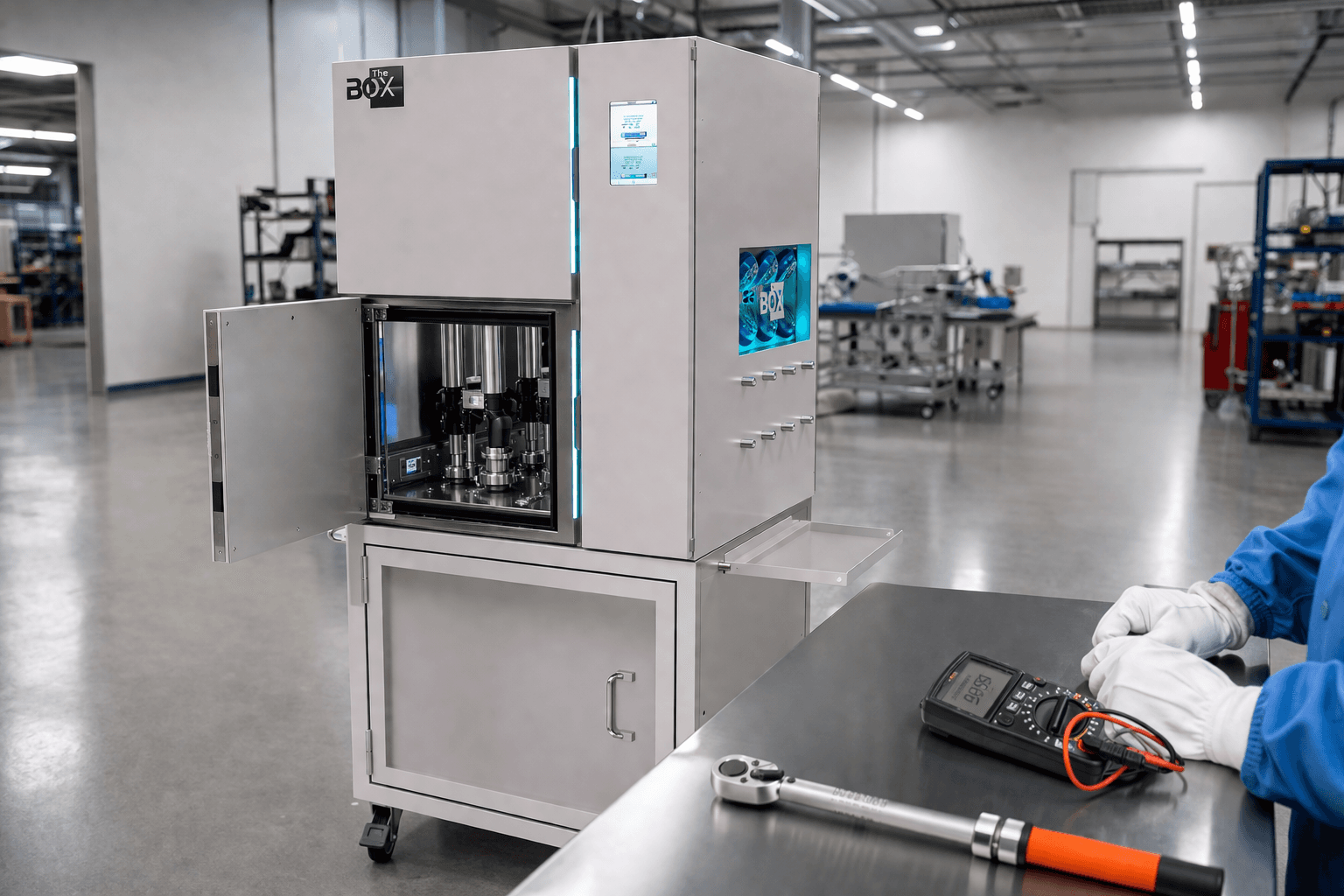
Custom Chamber Design
Parametric Process Control
Validation-Integrated Build
Delivery & Commissioning
Material Scope
Compatible Materials
VHP sterilization is broadly compatible with the materials encountered in medical device, tissue processing, pharmaceutical, and industrial regulated applications.
Medical Polymers
PEEK, PTFE, polyethylene, polypropylene, silicone, PVC, ABS, polycarbonate
Metals & Alloys
Stainless steel, titanium, cobalt-chrome, aluminum, nitinol
Electronics
Sensors, circuit boards, battery-powered devices, microcontrollers
Biological Tissues
Allograft bone, soft tissue, dermis, amniotic membrane — non-irradiated
Optics & Fiber
Lenses, fiber optic cables, camera systems for minimally invasive devices
Composites
Multi-material assemblies, adhesive bonds, coated surfaces, laminates
HEPA & Filtration
Filter media processed without compromising integrity or particle ratings
Pharmaceuticals
Sterile fill/finish environments, isolators, cleanroom surfaces and equipment
Operational Scope Notice
PuroGen's R&D and manufacturing services are available for all regulated materials and substrates except THC-containing biomass, which falls outside our current operational scope. Cannabis and hemp purification applications are served through PuroGen's BoxPurify platform.
Material Compatibility Assessment
Specific material compatibility is assessed during the Phase 1 R&D engagement. Materials not listed here are not necessarily incompatible — they require targeted feasibility evaluation. Contact PuroGen to discuss your specific material profile before engagement.
Begin
Start with a Feasibility Study
A feasibility study is the lowest-risk entry point into a custom VHP sterilization capability. Bring your material or device to PuroGen's platform. We run the process. You get the data. If the data supports a custom system, we build it — to the parameters the data defines.
If the data reveals constraints that require design changes, you learn that before committing to a capital project. That is the point. The feasibility study exists to inform the decision, not to justify it.